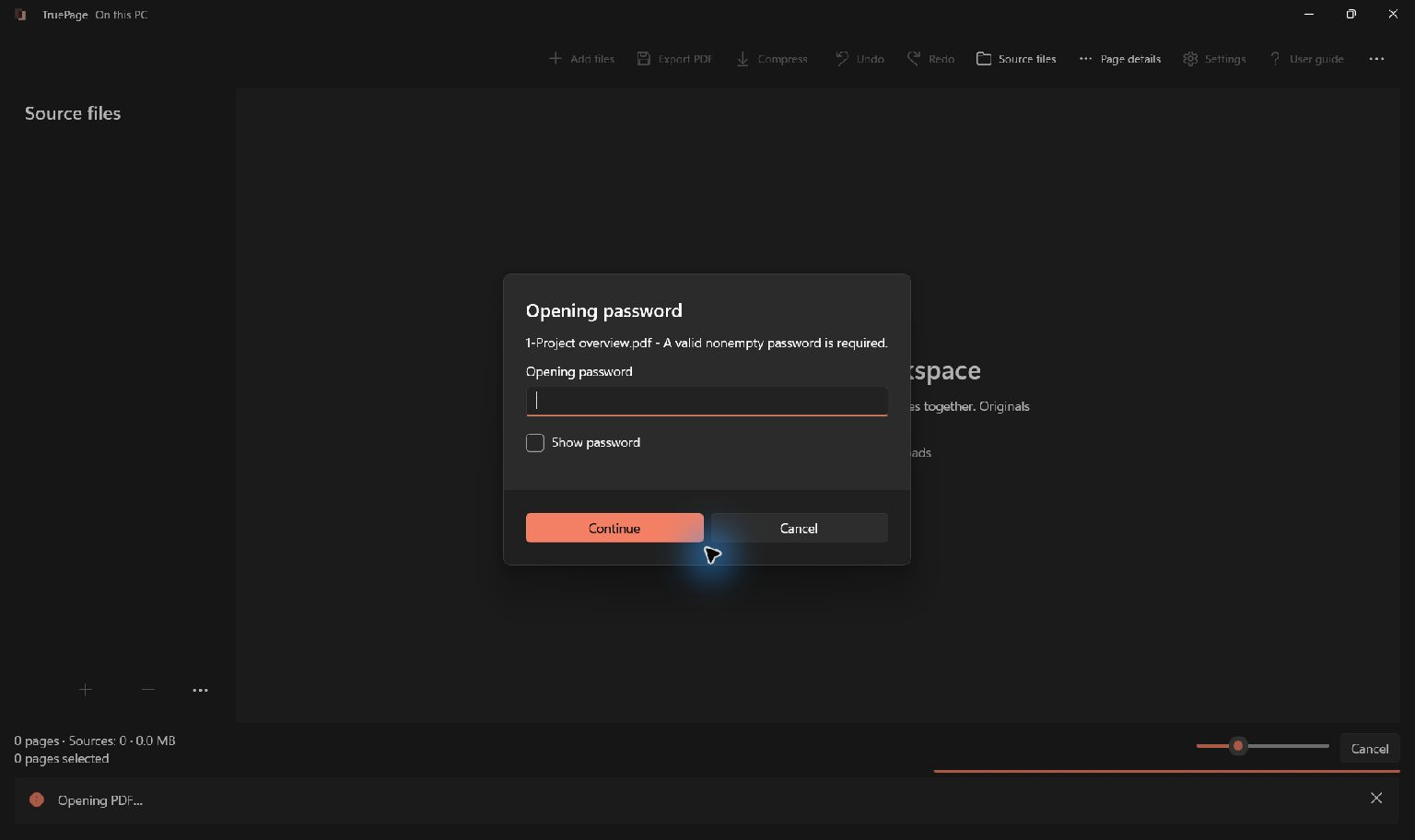
Add the intended PDF, use Add password to save an encrypted copy, and reopen that copy with the password. Export a combined or rearranged document first: password actions use the whole source PDF.
Add a password to a new copy
Password actions work on a whole source PDF, not the edited page arrangement. If you want protection on a combined or rearranged document, export that result first and then protect the exported PDF.
- Choose Add password from the toolbar overflow. If there are several PDF sources, select the intended source.
- Enter the new output filename and choose its destination.
- Review the source and output path. Confirm any existing-file choice.
- If the source is already encrypted, authenticate it when asked.
- Enter the new password and enter it again in Confirm password.
- Continue to create the new encrypted copy, then test opening that copy before sharing it.
Use a long, unique passphrase and keep it somewhere safe. Confirmation must match exactly as entered. Password preparation limits the result to 127 UTF-8 bytes, which is not the same as 127 characters. Unsupported controls, emoji and some Unicode combinations are rejected; follow the displayed message and choose supported characters.
Encryption helps prevent unauthorized opening. After a recipient opens a document, their software or device may still allow copying, printing, exporting or photographing it. Password protection is not a guarantee against redistribution.
Plan the document before arranging pages
Decide which exact PDF the recipient should receive. If it combines or rearranges pages, export that arrangement first and use the exported file as the password-operation source. Choose a long, unique passphrase and share it through an appropriate separate channel. Test the encrypted copy before sending it; adding a password does not secure unencrypted originals or stop an authorized reader from redistributing content.
Open a protected PDF
Add the PDF normally. When the app requests Opening password, enter a valid user or owner password and select Continue. A wrong-password message means you must try a valid password or cancel; TruePage does not recover unknown passwords.
Show password reveals what you entered, so use it only when appropriate for your surroundings. Passwords can be requested again for a new preview session, an export or after a language restart. An unlocked thumbnail is not permission to skip later authentication.
Organizing and converting encrypted input
Organized PDF exports and image/ZIP outputs from encrypted sources require an acknowledgement that the output will not be password-protected. Read that warning even if you previously opened the source successfully.
To share an organized result with a password, export the arrangement and then add protection to that new PDF. Image and ZIP output do not become password-protected merely because the input PDF was encrypted. Compression, by contrast, preserves existing source protection.
What stays local
Document processing runs in TruePage and its local worker processes. No TruePage account or document upload is required. Installing the app, Store updates, opening the website and other Windows services are separate activities.
Windows, backup tools and cloud-synced folders follow their own policies. Saving an output in a synchronized folder may cause that software to upload it. A local-processing statement is not a promise that the entire PC makes no network requests.
Protected-source exports can create unprotected PDFs, images or ZIP files after explicit acknowledgement. Choose destinations and sharing methods appropriate for those results. The workspace itself is not a permanent project archive: export what you need before closing.
For a safe first attempt, return to getting started.
TruePage does not provide OCR, existing-text editing, redaction or signatures. Rewriting a signed PDF does not preserve its valid signature status. Keep originals and follow operation-specific warnings. See the usage guide for complete procedures and limitations.
Related password tasks
Need to combine several protected files? Follow merging password-protected PDFs and protecting the combined file, including verification of the final output.
Already know the password and need a copy without it? Follow how to remove a PDF password on Windows 11, including saving and reopening the new copy.

Your pages. Your space.
Available now for Windows 11

